
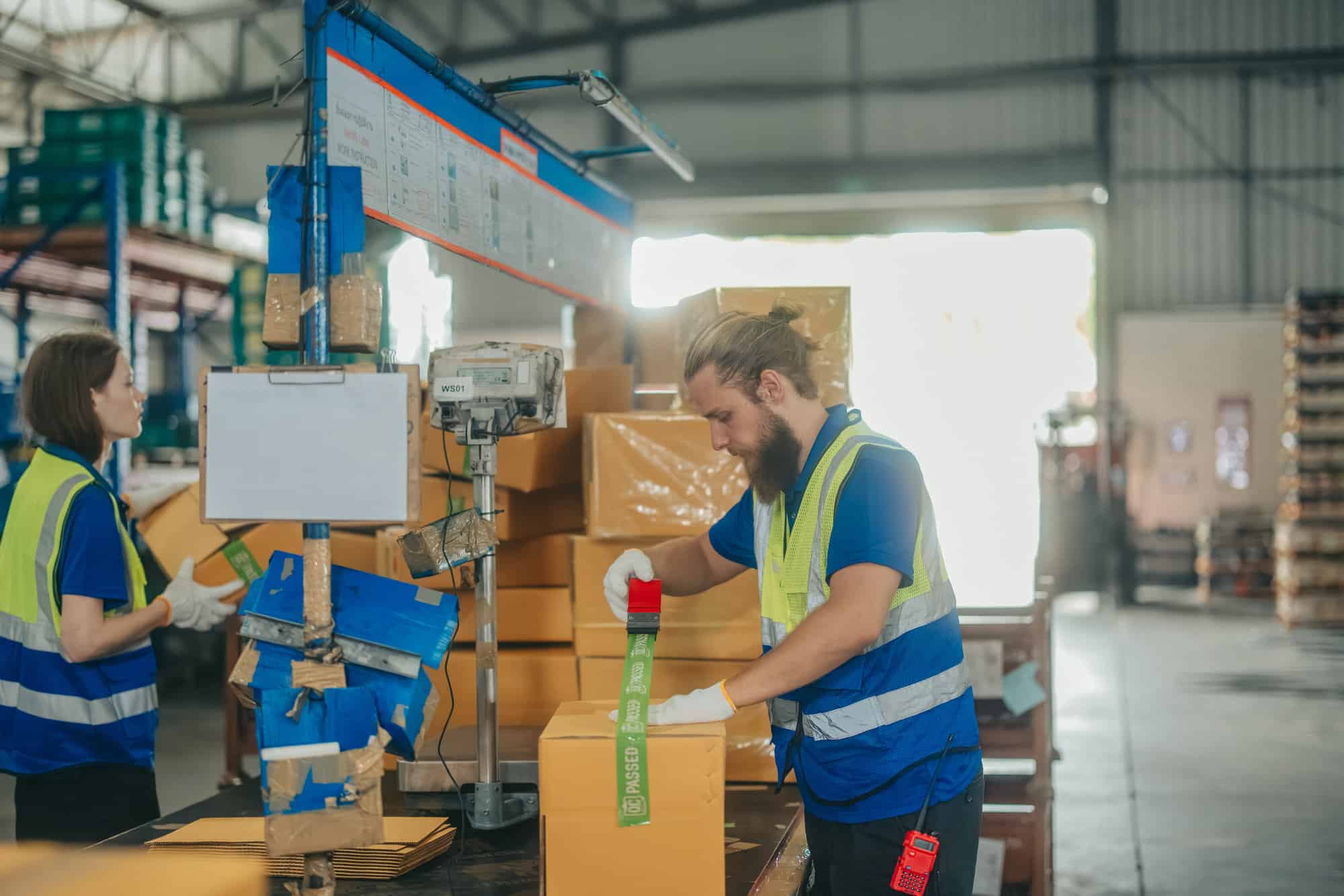
Automation can improve packaging and distribution operations at the end of the line as well as along the pick path. Many warehouses use warehouse management systems (WMS) to organize picking, and some are adopting autonomous mobile robots. Stations where orders are bagged, boxed, sealed, labeled and palletized often still rely on manual work, and that is where throughput stalls.
Automated bagging systems, case erectors and sealers, print-and-apply labelers and semi-automatic stretch wrappers can reduce repetitive handling and some lifting tasks associated with workplace injury risks. They may also make daily output less sensitive to staffing fluctuations.
U.S. retail e-commerce sales reached $340.2 billion in the second quarter of 2026, up 12.2% year over year and equal to 17.1% of all retail sales, according to the U.S. Census Bureau’s Quarterly Retail E-Commerce Sales report. Growth in orders for physical goods places added pressure on packaging operations. One practical approach is to automate one constrained station at a time, starting with the task that creates the daily backlog, rather than buying a full line at once.
Where does a packing line actually lose throughput?
A packing line moves only as fast as its slowest station, and the bottleneck may sit after picking. Adding pickers may not improve output if cartons queue at a case sealer or pallets wait to be hand-wrapped.
The labor data shows how little extra headcount has bought. According to the Bureau of Labor Statistics industry profile for warehousing and storage (NAICS 493), labor productivity in the sector fell 11.5% in 2021, 11.0% in 2022 and 4.4% in 2023, then grew just 0.1% in 2024. Hours worked grew faster than output, especially in 2021 and 2022.
The four stations worth timing first
Operations managers who want to find the constraint should time four stations across a full week, including peak days. Pack-out covers choosing a bag or box, adding inserts and void fill, and closing the package. Sealing means taping or gluing cartons, or heat-sealing poly bags. Labeling is printing and applying shipping labels and matching them to the order. The last one, palletizing and wrapping, is where the load gets built and secured with stretch film.
Nassco, Inc., a family-owned packaging automation and janitorial solutions provider based in New Berlin, Wisconsin, has supported manufacturers, distributors, and ecommerce operations across Wisconsin, Iowa, and Illinois since 1955. Equipment providers can begin with an onsite assessment of where cartons and pallets queue up, helping determine whether the constraint is a stretch wrapper, case sealer or another station.
Which packaging tasks deliver the fastest payback when automated?
The fastest payback usually comes from the task with the most manual touches per order at the constrained station. Four categories account for most early end-of-line projects.
Automated bagging and pack-out
Automated bagging systems, such as AutoBag baggers, can open a pre-made poly bag and seal it, with some configurations also printing a shipping label. For apparel, soft goods and small parts, a bag can replace a corrugated box. That matters because parcel carriers bill on dimensional weight when it is higher than a package’s actual weight, so a smaller, lighter package can lower cost per package.
Consider a hypothetical regional ecommerce shipper packing 1,500 orders a day by hand. Picking keeps pace, but parcels stack up at pack-out every afternoon because each order needs a bag, an insert, a seal and a label. Moving that one station to an automated bagger that prints and applies the label in the same cycle could remove several manual touches per order and help reduce the afternoon backlog.
Case erecting, sealing and protective packaging
Case erectors form flat corrugated blanks into open cartons, and case sealers tape them shut at a consistent pressure and position. Foam-in-place systems such as Sealed Air’s Instapak mold cushioning around fragile or irregular items. Shippers that want evidence their packaging survives parcel networks can test against ISTA Procedure 3A, the International Safe Transit Association’s simulation test for parcel shipments of 70 kg (150 lb) or less, rather than relying on damage claims after the fact.
Print-and-apply labeling tied to the WMS
Mislabels are costly because they surface after the package has left the building. When connected to a WMS or shipping platform, print-and-apply labelers can use order data directly, reducing manual label matching and the potential for errors.
Stretch wrapping and pallet load stability
Turntable stretch wrappers rotate the pallet while the film carriage moves up and down. Rotary-arm wrappers keep the load still and move the film around it, which suits heavy or unstable loads. Either type can apply film at more consistent tension, helping improve pallet stability when the load and wrap settings are appropriate. Manual wrapping can be harder to standardize across shifts.
How do manual, semi-automatic and fully automatic packaging compare?
The choice is rarely “manual or automated.” Semi-automatic equipment, where an operator loads the machine and the machine performs the cycle, is often the right first step.
| Factor | Manual | Semi-automatic | Fully automatic |
|---|---|---|---|
| Throughput | Set by operator pace; varies by shift | Moderate and consistent | Highest; continuous conveyor infeed |
| Labor per station | One or more, more at peak | Usually one operator | Monitoring and material replenishment |
| Footprint | Smallest | Small to moderate | Largest, including conveyors and guarding |
| Changeover flexibility | Highest | High | Lower; depends on stored settings |
| Typical use case | Low volume, high SKU variety | Growing volume, mixed orders | High volume, consistent package formats |
A practical rule: go semi-automatic when one station becomes the constraint, and fully automatic when volume is high and package formats are stable.
How does automation change warehouse safety and labor planning?
End-of-line work is lifting-heavy work. The BLS reports that warehousing and storage recorded 4.8 injury and illness cases per 100 full-time workers in 2024, with 4.1 of those involving days away from work, job restriction or transfer. The Occupational Safety and Health Administration revised its National Emphasis Program on Warehousing and Distribution Center Operations (CPL 03-00-026) effective July 31, 2026, keeping it in place for five years. Inspections under the program include powered industrial vehicles, material handling and storage, walking-working surfaces and ergonomics.
Staffing is the second pressure. In PMMI’s 2025 Inside the Workforce Gap research, 95% of packaging end users said they struggle to find skilled operators and technicians. Automation shifts the job from repetitive lifting toward machine tending, which means training and planned maintenance become part of the purchase. Nassco, Inc. offers packaging equipment installation, operator training and planned maintenance services, because an automated stretch wrapper or bagger that sits idle waiting for repair recreates the bottleneck it was bought to fix.
Why floor care belongs in the automation plan
Stretch film scraps and corrugated dust collect around wrappers, conveyors and dock doors, and those floors are the same walking-working surfaces OSHA inspects. Autonomous floor scrubbers can handle scheduled cleaning in suitable areas, although setup, monitoring and maintenance still require staff.
What role do robots and software play beyond the packing station?
Robotics and software are changing how work reaches the packing station. In the 2026 MHI Annual Industry Report produced with Deloitte, 39% of supply chain leaders rated the impact of robotics and automation as significant or greater, up 16 percentage points, and respondents ranked workforce and talent shortages as the second-largest trend affecting supply chains.
Autonomous mobile robots now carry totes from pick zones to pack stations, and WMS-to-packing-station integration tells each station what is coming. Faster picking can increase the volume arriving at pack-out, potentially shifting the constraint to a manual end-of-line station. Software-driven AI automation across business operations follows the same pattern: automating one step moves pressure to the next. General-purpose humanoid robots draw attention, but for most packing lines, purpose-built baggers, sealers and wrappers remain the practical near-term option.
A practical sequence for deciding what to automate first
- Measure each station. Record throughput per hour at pack-out, sealing, labeling and wrapping across a full week, including peak days.
- Find the constraint. The station with the longest queue sets the pace for the whole line.
- Check the package mix. Share of orders that could ship in a bag instead of a box, average carton sizes, and fragile-item volume all change which machine fits.
- Start semi-automatic at the constraint. One machine at one station, sized for current peak volume plus growth.
- Connect labeling to the WMS. This can remove a manual matching step and reduce labeling errors.
- Budget for training and maintenance. Include operator training and a planned maintenance schedule in the project cost.
- Re-measure and repeat. Once the first constraint clears, the next slowest station becomes the new one.
Take a regional distributor hand-wrapping outbound pallets at two dock doors. Wrap quality varies by operator and some loads shift in transit. In the afternoon rush, trailers wait. A semi-automatic turntable wrapper at the busier door standardizes film tension and frees the operator to stage the next load. Step seven then shows whether the second door needs its own machine.
Basic data analytics practices make this sequence work: without baseline numbers for throughput per hour, cost per package and order accuracy, nobody can show what the first machine changed. That baseline also gives any equipment provider useful information for an onsite operational assessment.
Frequently asked questions
When does it make sense for a warehouse to automate end-of-line packaging?
The usual trigger is when manual packing, bagging or pallet wrapping becomes the throughput constraint, so orders back up at pack-out even though picking keeps pace. Many equipment providers assess the line onsite before recommending equipment, since a semi-automatic stretch wrapper or automated bagger often resolves the bottleneck without a full-line overhaul.
What is the difference between a turntable and a rotary-arm stretch wrapper?
A turntable wrapper rotates the pallet while film is applied. A rotary-arm wrapper keeps the pallet still and moves the film around it, which suits heavy, tall or unstable loads that should not spin.
What should a packaging automation project include besides the equipment?
An onsite assessment of current throughput, installation, operator training, and a planned maintenance program. Equipment uptime is one factor in whether the investment delivers its expected return.
How does OSHA’s warehousing emphasis program affect packing stations?
OSHA’s revised National Emphasis Program, effective July 31, 2026, allows comprehensive inspections that can cover material handling, powered industrial vehicles, walking-working surfaces and ergonomics. Packing stations with heavy repetitive lifting or cluttered floors fall within that scope.
What metrics show whether packaging automation is working?
Track throughput per hour at the automated station, cost per package, order accuracy, damage and return rates, and injury records for the affected tasks. Compare each against the baseline measured before installation.


