

What Does the Research Say About Accepting a Counteroffer?
Before making any decision, it helps to look at the data and the statistics on counteroffers are striking. According to multiple national surveys and recruiter studies, between 50% and 85% of employees who accept a counteroffer end up leaving their employer anyway, either voluntarily or involuntarily, within 6 to 12 months.
That means accepting a counteroffer has roughly a coin-flip (or worse) chance of actually solving the problem.
Research from the recruiting firm Eclipse found that roughly 80% of candidates who accepted a counteroffer from their current employer ended up leaving within six months.
A separate survey by CareerBuilder found that 56% of candidates don’t even negotiate for higher pay when first offered a job, suggesting that many workers undervalue themselves from the start and counteroffers only temporarily paper over that gap.
These numbers paint a clear picture: a counteroffer is rarely a long-term solution. It is typically a short-term fix to a long-term problem.
Many people are offered counteroffers when they hand in their resignation. Often, accepting a counteroffer will result in more negative outcomes than positive. There are a few reasons not to accept one.
Why accepting a counteroffer is a big mistake
When you accept a counteroffer, your loyalty will be questioned. You may not be getting paid enough initially. The counteroffer will not guarantee long-term satisfaction, and the job may not line up with your long-term goals.
There are a lot of mixed opinions about counteroffers and whether you should accept them or not. This article will discuss what they are, why people make counteroffers, and why you should not accept a counteroffer. Keep on reading.
What Is a Counteroffer?
A counteroffer is a response to an offer from a potential new employer. A person may give an offer (or a job resignation), then the receiver of the proposal may reject it, but provide a different proposition. This is called a counteroffer.
People make counteroffers when the receiver is interested in accepting the initial terms that were offered to them, but there needs to be some changes in the offer for them to take it. When responding to a counteroffer, one usually accepts it, rejects it, or makes another offer.
Even though counteroffers often look like an attractive option, there are many reasons why you should not accept them.
What Are the Different Types of Counteroffers?
Not all counteroffers are created equal. Understanding the type of counteroffer you’re receiving can help you better evaluate whether it’s worth considering.
Salary-Only Counteroffers
The most common counteroffer involves simply matching or exceeding the salary offered by your new employer. While a pay bump can be enticing, it rarely addresses any non-monetary issues such as a toxic work culture, limited advancement opportunities, or poor work-life balance that contributed to your desire to leave.
Promotion or Title-Based Counteroffers
Some employers will offer a promotion or a new title alongside a salary increase. While this sounds more substantial, it’s important to ask whether the promotion was already in the pipeline or whether it has only materialized because you threatened to leave. If the latter, it signals that advancement at this company may only come under duress.
Promises of Future Change
This type of counteroffer involves an employer promising future improvements — a better project, a new manager, more flexibility, or improved resources. These verbal promises are the most dangerous type because they are the hardest to hold someone accountable for. Always ask: why weren’t these changes made before you had to resign?
Hybrid Counteroffers
Some counteroffers include a combination of a pay raise, new title, additional benefits, and verbal promises. These can feel overwhelmingly generous in the moment, but the same question applies to each component: does this actually fix the underlying reasons you wanted to leave?
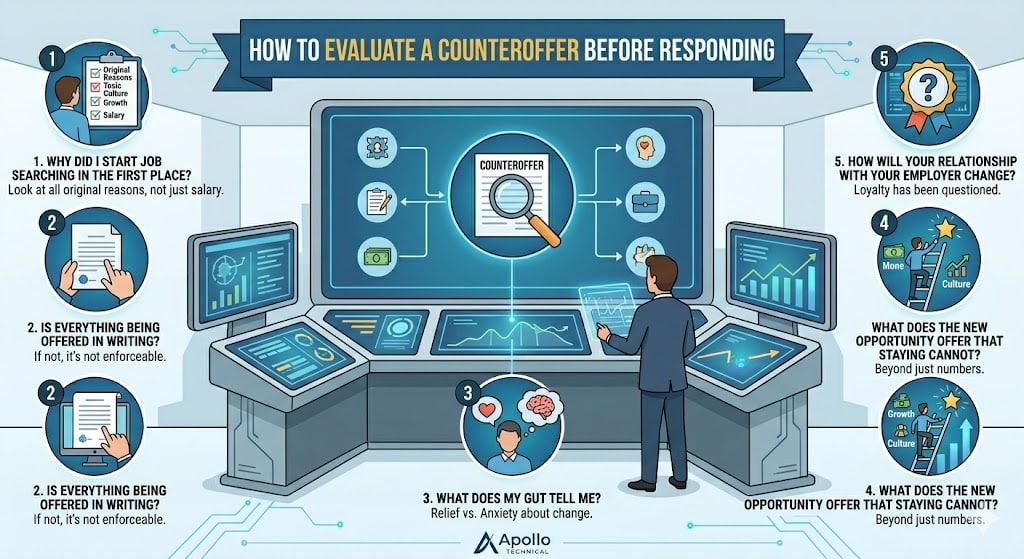
How to Evaluate a Counteroffer Before Responding
If you’ve received a counteroffer and are unsure what to do, a structured evaluation can help you make a more objective decision. Here are the key questions to ask yourself:
1. Why did I start job searching in the first place?
Write down the original reasons all of them, not just salary. Be specific. Then look at the counteroffer and ask honestly: does it fix all of those reasons, or just one?
2. Is everything being offered in writing?
Any promises made verbally during the counteroffer stage are essentially unenforceable. If the terms aren’t documented, they may not be honored.
3. What does my gut tell me?
If you feel relieved when you imagine walking away from your current employer, that’s a signal. If you feel genuine enthusiasm at the idea of staying not just relief from the anxiety of change that’s worth weighing too.
4. What does the new opportunity offer that staying cannot?
Consider culture, growth trajectory, mentorship, technology, brand name, and work-life balance not just the numbers.
5. How will your relationship with your employer change?
Even if your boss seems enthusiastic about you staying, the dynamic has shifted. Your loyalty has been questioned. This subtle change can affect your experience at work in ways that are hard to quantify.
How Accepting a Counteroffer Affects Your Relationship With Coworkers
One angle that often goes overlooked is the impact a counteroffer acceptance can have on the team around you. When colleagues learn that you nearly left and received a significant raise or promotion as a result it can create resentment and tension in the workplace.
Some coworkers may begin to question whether they should also threaten to resign in order to receive similar treatment. Others may simply feel that you’ve been rewarded for disloyalty, which can erode the trust and camaraderie that makes a workplace enjoyable. Managers, too, may begin to question whether any employee who has ‘threatened to leave’ can be relied upon for important projects or leadership roles.
According to Indeed’s career guidance resources, if coworkers learn that you’re earning a significantly higher salary after the counteroffer, they may feel entitled to the same treatment or simply lose respect for you professionally. This dynamic can be especially damaging on smaller teams where close collaboration is essential.
Are There Cases When Accepting a Counteroffer Makes Sense?
While the evidence strongly suggests that accepting counteroffers is a losing bet in most scenarios, there are some narrow cases where it may be the right move:
Your only issue was salary:
If you genuinely love your job, your team, and your company and salary was the sole reason you were open to other opportunities then a competitive counteroffer may be entirely reasonable. The key word here is ‘sole.’ Most people who hand in resignations have more than one grievance.
The new offer comes with significant unknowns:
If the new job involves relocating, a startup with uncertain funding, or a role with considerably more risk, it may be worth staying put if your current employer can match the compensation and provide stability.
The counteroffer includes real, written structural changes:
If your employer responds to your resignation with a documented promotion plan, a reporting structure change, and a clear path to the role you’ve been asking for and these are legally binding commitments then the calculus changes.
Even in these cases, proceed carefully. Make sure you get everything in writing, revisit your original reasons for leaving, and give yourself at least 48 hours before responding to any counteroffer. Decisions made in emotional moments rarely age well.
11 Reasons not to accept a counteroffer
1. An underlying issue isn’t solved by a counteroffer
A lot of times, there are several reasons you may want to leave your job. It could be obvious things like work hours or coworkers, or it could be unconscious in the sense you just do not like the job in general.
This can be a problem when you receive a counteroffer where the only thing that changes is the salary. Increased pay will be an attractive option at first, and this compels most people to accept the offer.
This can be an issue three months down the line when you are unhappy again because it was not just the salary you were dissatisfied with.
If there are multiple reasons you want to change jobs and receive a counteroffer with an increased salary, the best thing to do is to reject it. Odds are, you will experience long term happiness and personal satisfaction at another job that is more suited to you than your current role.
2. There Is No Chance for Career Progression
Often when you are receiving counteroffers and job offers, it is easy to accept it without too much thought because of how appealing the offer may look.
A significant factor when thinking about counteroffers is if there is a chance for career development and progression. If you are searching for a long term job, possibilities of career progression should make or break your decision.
Jobs take a lot of time and energy, and it is best to put your energy into something that will have great payoff later.
It is also good to think about the highest position in the job (that you could be promoted to) and if you would be happy with that.
3. Loyalty Will Be Questioned After a Counteroffer
It does not matter how good your relationship is with your employer, if you are receiving a counter-offer as a response to your resignation, your loyalty will be questioned as an employee both then and in the future.
Even if the job has room for promotions and professional growth, you probably will not be the first employee they pick at promotion time.
Resigning breaks the initial trust that was once there, and it will hinder future success at the job. So even if the counteroffer is a good deal, you are likely to progress more at a new job where you have not threatened to quit.
4. Job Does Not Meet Your Long Term Goals
People will often hand in resignations or look for jobs when their current position does not fit the picture they had for their ideal life or goals. If you accept a counteroffer, you could potentially be denying yourself your dream job.
When thinking of accepting a job offer or counteroffer, you should make sure that the position meets your long-term goals either now or in the future.
There is no point in investing time and energy into something you do not want to be doing for the rest of your life. So before you accept a counteroffer, think of why you wanted to quit in the first place. Is the job making you happy?
5. You Might Not Be Appreciated as an Employee
If you hand in your resignation and your employer gives you a counteroffer, it may suggest that you were not fully appreciated in the first place as a valuable employee.
The offer is proof that they can offer more money or office space, for instance, and that they were initially holding out on you.
If it takes you to threaten resignation for the company to treat you better, you might need to evaluate the company’s integrity.
6. It Will Not Guarantee Job Satisfaction
People hand in resignations and look for new jobs when they are not satisfied with their current position. A counteroffer may give hope of better working conditions and salary, but statistics show that this is often not the case.
Around 50% of people who accept counteroffers leave for a new job within 12 months. Just because the offer may seem like a good option, it won’t guarantee job satisfaction down the line.
If you find yourself on the hunt for a career and are not sure how to start, check out the book What Color Is Your Parachute? 2020: A Practical Manual for Job-Hunters.
7. Employer Doesn’t Know How Long You Will Stay
If you end up accepting a job counteroffer, your employer will always be questioning how long you will stay at the job since you were so willing to quit.
This could result in similar problems, as mentioned above, such as hindering your future success in the position. You are more likely to be viewed as expendable than other employees who have not handed in resignations.
8. Your Employer Might Not Be Paying You Enough
A lot of counteroffers involve a pay raise, which may seem very tempting to accept if the higher salary if it is the main reason you handed in your resignation.
Before you agree to a counteroffer with a pay raise, it is crucial to question why you have not had a pay raise before. When this happens, it is good to do some research using a salary guide and find out what you should be earning.
If you were not earning what you should have been before the counteroffer, it might be good to consider leaving the company for another that will appreciate your work.
9. It may be a long time before you get another raise
Think about it if you were leaving your current employer because you felt you were not getting paid enough and they only way to get a raise was to offer your resignation then the odds of you getting a raise in the future are slim.
10. If times get tough you may be the first to go
If your current employer experiences hard times or if the economy, in general, gets bad they are more likely to hang on to employees that have shown loyalty rather than ones who have been job shopping for another opportunity.
11. Counteroffers can be a stall tactic
Often employers will pay you more because they know it will only be for a short while. They will then start searching for a replacement who will take a lower salary with a similar skillset to yours.
This is one reason why you should never accept a counteroffer.
How long does it take to get a counteroffer?
Generally, you should get a counteroffer within a week or less often in the first 1 to 3 days if you will receive one at all.
How do I decline a counteroffer?
Politely tell your current employer that you appreciate them wanting to keep you, and you learned a lot in your current position. However, your new position offers better career growth or work-life balance and money is not the main motivator in your decision.
Conclusion
There are a lot of reasons you may receive a job counteroffer, and there are a few factors to consider before accepting one.
It would be best if you did not accept a counteroffer when it is more than the salary you are unhappy with, when the job does not have room for promotions, and when the career does not fit your long term goals.
Some negative things can happen when you accept a counteroffer at your current company. Your loyalty could be questioned making it a hostile work environment, you might not be satisfied with the job in the long term, you might not be appreciated as an employee, and you might not be getting paid enough.
Looking for a new engineering or other technical role? Reach out one of the leading engineering staffing agencies Apollo Technical today.
