
Custom injection molding is one of the most advanced and efficient manufacturing processes used today. This enables businesses to produce highly accurate, complex and repeatable plastic components tailored to specific requirements. From auto parts to medical equipment, custom injection molding plays an important role in modern industry.
In this comprehensive guide, we’ll explore how custom injection molding works, its benefits, applications, materials, and key considerations when choosing a manufacturing partner.
Custom injection molding is one of the most advanced and efficient manufacturing processes used today. This enables businesses to produce highly accurate, complex and repeatable plastic components tailored to specific requirements. From auto parts to medical equipment, custom injection molding plays an important role in modern industry.
In this comprehensive guide, we’ll explore how custom injection molding works, its benefits, applications, materials, and key considerations when choosing a manufacturing partner.
What is Custom Injection Molding?
Definition and Overview
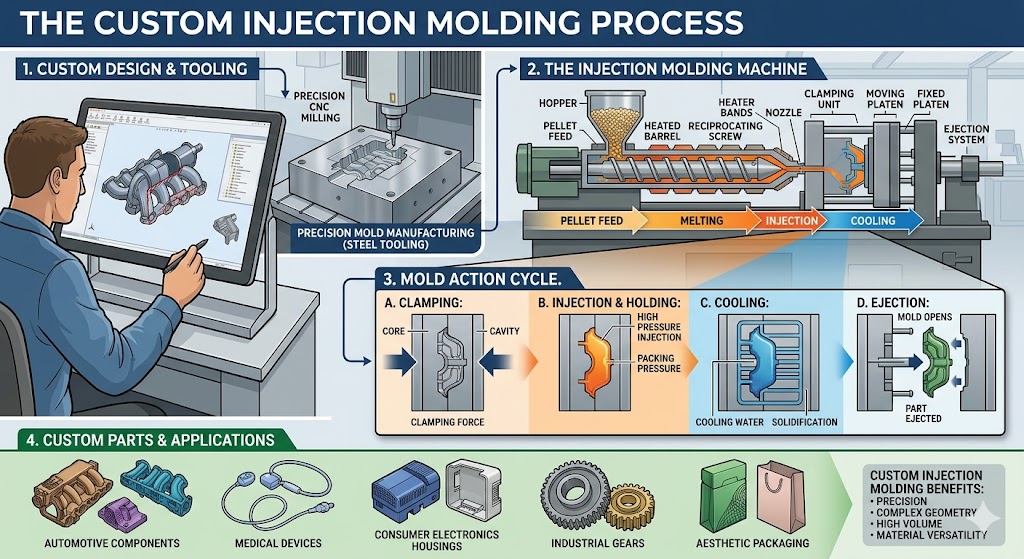
Custom injection molding is a manufacturing process in which molten material usually plastic is injected into a specially designed mold to create parts with precise dimensions and specifications. Unlike standard molding, custom injection molding is made to meet unique design specifications, making it ideal for specialized applications.
How the process works
The process starts with designing a mold based on the desired product. The raw material is heated until it melts, and then injected into the mold cavity under high pressure. Once cooled and solidified, the part is extruded, resulting in a finished component that requires minimal finishing.
Key Benefits of Custom Injection Molding
High Precision and Consistency
One of the greatest advantages of custom injection molding is its ability to produce parts with extremely tight tolerances. This makes it ideal for industries where precision is important, such as medical and aerospace manufacturing.
Cost effective for large production
While initial tooling costs can be high, custom injection molding becomes very cost-effective for larger production runs. Once the mold is made, thousands or millions of identical parts can be produced quickly and economically.
Materials Used in Custom Injection Molding
Common Thermoplastics
A variety of materials can be used in custom injection molding, including ABS, polypropylene, polyethylene, and polycarbonate. Each material offers different properties such as strength, flexibility and heat resistance.
Specialty and engineering plastics
For more demanding applications, plastics such as nylon, PEEK and polyetherimide are often used. These materials provide superior durability, chemical resistance and performance in extreme conditions.
Applications of Custom Injection Molding
Automotive and Aerospac
Custom injection molding is widely used in the automotive and aerospace industries to produce lightweight, durable components. These include the dashboard, connectors, housing and structural parts.
Medical products and consumer products
In the medical field, custom injection molding is essential for the production of sterile and precision instruments such as syringes, surgical instruments and diagnostic equipment. It is also used in consumer products such as packaging, electronics and household items.
The Custom Injection Molding Process
Mold Design and Prototyping
The first step in custom injection molding is to design the mold using CAD software. Prototypes are often made to test designs before full-scale production begins. This ensures that any problems in the process are resolved quickly.
Production and quality control
Once the mold is complete, production begins. Advanced machines inject the material into the mold with high precision. Quality control measures, such as inspection and testing, are implemented to ensure that each part meets specifications.
Design Considerations for Custom Injection Molding
Wall Thickness and Geometry
Uniform wall thickness is important in custom injection molding to prevent defects such as distortion or shrinkage. Designers must also consider geometry to ensure proper material flow and cooling.
Material selection and tolerances
Choosing the right material is crucial to achieving the desired performance. Tolerances must be carefully defined to ensure that the parts fit and function correctly in the intended use.
Choosing the Right Custom Injection Molding Partner
Experience and Expertise
When choosing a supplier, it is important to consider their experience with custom injection molding. A knowledgeable partner can provide valuable insight into design, materials and production processes.
Technology and capabilities
Look for manufacturers that use modern equipment and advanced technology. This ensures higher precision, faster production and a better overall result.
Future Trends in Custom Injection Molding
Automation and Smart Manufacturing
The integration of automation and smart technologies is transforming custom injection molding. Robotics and AI-powered systems improve efficiency, reduce errors and lower production costs.
Durable materials
As the industry moves towards sustainability, the demand for biodegradable and recycled materials in custom injection molding is increasing. This trend is expected to shape future production.
Conclusion
Custom injection molding is a powerful and versatile production process that enables the production of high-quality, precise and cost-effective components. Its ability to handle complex designs, wide material choices and large-scale production makes it an essential solution in many industries.
By understanding the process, benefits and key ideas, companies can take advantage of custom injection molding to achieve better product performance and competitive advantage. As technology continues to advance, custom injection molding will remain at the forefront of precision manufacturing.
FAQs
1. What is custom injection molding used for?
Custom injection molding is used to create precision plastic components for industries such as automotive, medical, electronics, and consumer goods.
2. Is custom injection molding expensive?
Initial tooling costs may be high, but custom injection molding becomes cost-effective for larger production volumes.
3. What materials are used in custom injection molding?
Common materials include ABS, polypropylene, polyethylene, nylon and other engineering plastics.
4. How long does the custom injection molding process take?
The timeline depends on design complexity, mold construction and production volume. This can vary from a few weeks to several months.
5. What are the benefits of custom injection molding?
Important advantages include high precision, repeatability, scalability and low material waste.
