

Introduction
In today’s rapidly evolving tech landscape, technical expertise is essential but the conversation has moved past “which matters more” to something more important: how hard skills and Power Skills integrate with AI to create professionals who are genuinely irreplaceable.
As automation and AI agents commoditize routine technical tasks, the professionals who excel in collaboration, adaptability, critical thinking, and ethical judgment are emerging as the most valuable hires in the market. The framework has shifted. The synthesis is what matters now. Organizations working through this transition can turn to EvolveUp for guidance on workforce transformation, talent strategy, and aligning people with emerging technology.
“Soft skills enable professionals to navigate the complexities of a tech-driven world with a human-centered approach,” says Sai Blackbyrn, CEO of Coach Foundation
92% of hiring managers say Power Skills are as important as hard skills (LinkedIn) 78% of IT roles now require AI-related expertise alongside traditional technical foundations 62% of hiring managers report a wider skills gap than last year, specifically in finding candidates who can translate AI data into business strategy
2026 Skills Audit
Check each skill where you can honestly answer yes to the question below it.
AI Literacy (Hard Skill) Technical description: Prompt engineering, AI output validation, and model evaluation. Self-check: Can you write effective prompts and critically evaluate AI-generated outputs for accuracy?
Cybersecurity Fundamentals (Hard Skill) Technical description: Threat awareness, zero-trust principles, and secure system design. Self-check: Do you understand modern threat vectors and apply security-first thinking to your work?
Communication (Power Skill) Description: Translating technical AI data into clear business strategy for non-technical stakeholders. Self-check: Can you explain a complex AI output or technical finding to a non-technical executive in under 2 minutes?
Critical Thinking (Power Skill) Description: Catching AI hallucinations, questioning outputs, and reasoning under uncertainty. Self-check: Do you routinely verify AI-generated content and challenge assumptions before acting on them?
Adaptability (Power Skill) Description: Pivoting quickly as tools, roles, and processes evolve with AI integration. Self-check: Have you proactively learned a new AI tool or workflow in the past six months without being required to?
The Human-AI Power Couple
The most valuable hire in 2026 is not the best coder or the best communicator. It is the professional who uses AI to handle the repetitive, high-volume technical tasks freeing their uniquely human Power/Soft Skills for the work that actually moves an organization forward: client relationships, ethical judgment, creative strategy, and the critical thinking required to know when to trust the machine and when to override it.
Neither the human nor the AI alone produces what they produce together. That combination is what organizations are paying a premium for.
Top 10 IT Skills for 2026: The “Power Couple” of Tech
To move your article into a top-ranking position, it needs to reflect the current 2026 reality: Hard skills provide the foundation, but “Power Skills” (soft skills) provide the ROI. Below is a curated list of the top 10 skills that hiring managers are prioritizing this year. You can add this directly to your article as a “2026 Outlook” section.
The Technical “Hard” Skills
- Agentic AI & Prompt Engineering It’s no longer just about using a chatbot. Companies want IT pros who can build and manage “AI Agents” autonomous systems that perform multi-step tasks. Mastering the Model Context Protocol (MCP) is the newest “it” skill for 2026.
- Cybersecurity (AI-Driven & Cloud-Native) With AI-powered threats on the rise, skills in threat detection automation and zero-trust architecture are non-negotiable.
- Data Literacy & Interpretation As AI generates more data, the value lies in those who can interpret it. Being able to separate “signal from noise” and validate AI-generated insights is a top priority.
- Cloud Architecture (Multi-Cloud & Hybrid) Companies are moving away from single-provider dependency. Proficiency in managing workloads across AWS, Azure, and Google Cloud simultaneously is a massive differentiator.
- Automation & Low-Code Development The ability to use Python or low-code platforms to automate repetitive business workflows is essential for “lean” IT teams in 2026.
The Human “Power” Skills
- Critical Thinking (AI Validation) This is the #1 soft skill of 2026. As AI handles more execution, humans must act as the “quality control,” identifying hallucinations and ensuring technical outputs align with business logic.
- Adaptability & “Teachableness” The “half-life” of a technical skill is now roughly 5 years. Hiring managers are looking for a “growth mindset” the proven ability to unlearn old systems and master new AI tools in weeks, not months.
- Complex Problem Solving AI is great at solving known problems. Humans are needed to define the right problems to solve, especially when technical requirements clash with ethical or budgetary constraints.
- Cross-Functional Communication IT is no longer a silo. The most successful 2026 hires are “translators” who can explain complex AI or security risks to non-technical stakeholders in terms of ROI and Risk Mitigation.
- Emotional Intelligence (EQ) & Leadership In an era of remote and hybrid work, the ability to maintain team cohesion, manage burnout, and lead with empathy is what separates a senior engineer from a “tech lead.”
1. Understanding the Two Skill Categories in 2026
The old framing hard skills vs. soft skills no longer captures what employers actually need. Industry leaders including Robert Half and Korn Ferry now use the term Power Skills to describe what were previously called soft skills, reflecting their true strategic weight in hiring and promotion decisions. The word “soft” implied these abilities were secondary. They are not.
In 2026, the hard skill floor has risen sharply. Basic coding, routine data processing, and templated technical work are being handled or accelerated by AI agents. The hard skills that command attention now are AI literacy, cybersecurity architecture, and cloud-native development. The Power Skills that unlock leadership are emotional intelligence, adaptability, and the critical thinking required to catch what AI gets wrong.
“Soft skills enable professionals to navigate the complexities of a tech-driven world with a human-centered approach.” — Sai Blackbyrn, CEO of Coach Foundation
Hard Skills (2026 Context) vs. Power Skills
Definition: Technical AI literacy, Cybersecurity, Cloud Architecture vs. Emotional Intelligence (EQ), Adaptability, Ethical Judgment.
AI Impact: Tasks are accelerated and automated by AI agents vs. Cannot be replicated by AI — essential for team cohesion and human judgment.
Evaluation: Technical assessments and AI-literacy certifications vs. Behavioral interviews and scenario-based problem solving.
Market Value: Gets you the interview vs. Gets you promoted to leadership.
2. The AI-Augmented Skills Gap
The Great Skills Gap of 2026 is not what most people expect. It is not a shortage of people who can code. It is a shortage of people who can do what AI cannot.
Seventy-eight percent of IT roles now require AI-related expertise alongside traditional technical foundations. But the more telling number is this: 62% of hiring managers report a wider skills gap than last year, and the specific gap they cite is the inability to find candidates who can translate technical AI outputs into business strategy. That translation requires both hard and Power Skills simultaneously — and most candidates have developed only one.
The New Hard Skill: In 2026, Prompt Engineering and AI Output Validation are the hard skills that distinguish competitive candidates. The ability to direct an AI model effectively, then verify its outputs critically, is more marketable than basic programming proficiency in most mid-level tech roles.
The corresponding Power Skill is Critical Thinking — specifically, the ability to catch AI hallucinations, challenge model assumptions, and identify when a confident-sounding output is factually wrong. AI systems do not flag their own errors. That responsibility falls entirely on the human in the loop, and most organizations are discovering they don’t have enough humans who are good at it.
“In tech, Power Skills are not merely add-ons to technical expertise — they’re essential tools for effective collaboration and innovation.” — Scott Trachtenberg, CEO of ADA Site Compliance
3. Key Power Skills That Drive Success in Technology Roles
Some Power Skills are essential across all tech roles, but each position requires a different emphasis. Communication now means something specific: the ability to translate what an AI model produced into a business recommendation a non-technical executive can act on. That is a harder skill than it sounds, and 62% of companies say they can’t find enough people who have it.
Emotional intelligence has taken on new importance as AI handles more cognitive load. When the routine thinking is delegated to tools, what remains — managing relationships, reading team dynamics, navigating conflict — is entirely human work. The leaders who thrive in AI-augmented environments are those with high EQ, not just high IQ.
Adaptability has always been valued. In 2026 it is non-negotiable. The half-life of a specific technical skill is shrinking. A developer who learned a framework two years ago may find it partially obsolete today. The professionals who compound their value over time are those who can absorb new tools quickly and transfer their reasoning skills to unfamiliar domains.
“In a field defined by rapid change, adaptability is the anchor that keeps tech teams resilient and future-focused.” — Dan Huang, Founder of Bonjola
2. Understanding Power Skills
Power skills are the intangible abilities that allow individuals to engage effectively with others. Unlike hard skills, which are technical, measurable, and job-specific, soft skills are often more challenging to quantify but are invaluable for creating productive work environments.
In tech-driven workplaces, these skills are particularly valuable for fostering collaboration and adaptability. Here are some key soft skills relevant to a tech environment:
- Communication: The ability to convey ideas effectively and clearly to diverse audiences, ensuring team alignment and mutual understanding.
- Teamwork: Encourages collaborative effort within teams, fostering a culture focused on shared goals.
- Adaptability: Enables professionals to adjust and thrive in constantly changing technological landscapes.
- Problem-Solving: Drives innovation and solution-oriented thinking through analytical skills and creativity.
- Emotional Intelligence: Recognizing and managing one’s own emotions and those of others, fostering a supportive, empathetic environment.
These skills go beyond facilitating day-to-day tasks; they shape the culture and effectiveness of teams by reducing misunderstandings, building trust, and supporting creativity.
“In tech, soft skills are not merely add-ons to technical expertise; they’re essential tools for effective collaboration and innovation,” says Scott Trachtenberg, CEO of ADA Site Compliance.
3. The Importance of Power Skills in a Tech-Driven Environment
In an environment where technology is ever-present, soft skills play a vital role in complementing technical knowledge. They enhance productivity, encourage innovation, and nurture an inclusive, high-performing culture. Here’s how soft skills contribute to creating a balanced and highly functional workplace:
- Enhanced Productivity: In tech environments, communication breakdowns can lead to costly errors and delays. Strong communication skills help teams align quickly, ensuring clear understanding and allowing projects to move forward smoothly and efficiently.
- Catalysts for Innovation: Creativity and problem-solving are essential in tech roles where fresh challenges are a constant. Professionals who can think on their feet, view issues from multiple perspectives, and apply solution-oriented thinking bring new ideas that drive the company forward.
- Strengthening Company Culture: Soft skills foster empathy, inclusivity, and understanding, creating a culture that values diverse perspectives and continuous improvement.
For example, imagine a software engineering team working under a tight deadline. If team members communicate clearly and adapt to changing priorities, they can avoid roadblocks and complete projects more swiftly.
By fostering emotional intelligence and teamwork, they create a motivated, supportive environment where each person can contribute their best, ultimately boosting both individual performance and team success. This balance of technical and soft skills turns challenges into opportunities for growth and innovation, cultivating a resilient workplace culture.
“In a field defined by rapid change, adaptability is the anchor that keeps tech teams resilient and future-focused,” says Dan Huang, Founder of Bonjola
4. Key Power Skills That Drive Success in Technology Roles
Some soft skills are essential across all tech roles, but each position may require a unique combination of these skills for optimal success. Here’s a closer look at the specific impact of key soft skills:
- Communication: Effective communication is vital for team cohesion and interactions with clients and stakeholders. It ensures that technical challenges and project progress are conveyed clearly, making complex information accessible to both technical and non-technical audiences.
- Teamwork: In collaborative projects, especially those involving cross-functional teams, teamwork is indispensable for aligning diverse expertise and focusing on shared goals. It fosters a cooperative environment where knowledge and ideas can flow freely.
- Emotional Intelligence: This skill aids in managing stress and fostering empathy, which is particularly beneficial in high-pressure roles like IT project management or cybersecurity. Emotional intelligence helps individuals understand and respond sensitively to colleagues’ emotions, creating a supportive atmosphere.
- Adaptability: In agile tech environments, change is a constant. Adaptability allows professionals to pivot quickly, learn new tools, and adjust to updated requirements, making them resilient in the face of evolving demands.
- Problem-Solving: Many technical challenges require creative solutions. Strong problem-solving skills enable tech professionals to approach issues proactively, identifying and implementing effective resolutions that drive project success.
For example, a cybersecurity analyst with high emotional intelligence can manage the intense pressure of constant vigilance while showing empathy toward teammates. Their adaptability enables them to respond swiftly to security threats, making them a critical asset to the team and reinforcing the company’s security posture.
“In cybersecurity, problem-solving and adaptability are as essential as technical acumen—threats evolve, and so must we,” says Stuart Blackburn, Managing Director of Eco Paper Cups.
5. The Impact of Power Skills on Career Advancement in Tech
In a highly competitive tech landscape, soft skills are often what set professionals apart. While technical abilities may secure a job, it is frequently the soft skills that open the doors to promotions and leadership roles.
According to LinkedIn’s Global Talent Trends, 92% of hiring managers believe that soft skills are as crucial as, if not more important than, hard skills. In tech roles where specialization is high, skills like adaptability, effective communication, and problem-solving are essential in making professionals more versatile and adaptive, thus enhancing their long-term career trajectory.
Take, for example, the journey of a software engineer advancing to a team lead position. While technical expertise is critical in their role as an individual contributor, the transition to leadership requires more than just coding prowess.
A team lead needs strong empathy to understand team members’ challenges, clear communication to align everyone on project goals, and problem-solving abilities to navigate unforeseen issues. Managing and inspiring a team requires these soft skills to build trust, motivate individuals, and foster a productive work environment.
In tech, where technical abilities may be relatively standardized across candidates, it’s often the capacity to lead, collaborate, and adapt that truly distinguishes a professional’s career path and potential for advancement.
| Power Skill | Impact on Career Advancement | Example in a Leadership Role |
| Communication | Essential for conveying ideas, aligning team goals, and fostering transparency | Clearly communicates project objectives and provides feedback |
| Teamwork | Builds collaborative relationships and facilitates cooperation among team members | Promotes a supportive team culture where everyone contributes |
| Empathy | Helps leaders understand team challenges and individual needs | Recognizes team members’ struggles and offers support |
| Adaptability | Allows leaders to pivot strategies based on changing project requirements or goals | Quickly adjusts to new project requirements and guides team accordingly |
| Problem-Solving | Enables leaders to handle unexpected issues and implement effective solutions | Analyzes and addresses project roadblocks creatively and proactively |
| Emotional Intelligence | Fosters trust and manages team morale, especially under pressure | Maintains composure during stressful situations and supports the team |
“Career growth in tech isn’t just about what you know; it’s about how you lead, communicate, and inspire others.” says David Tang, CEO & Founder of Flevy.
6. Developing and Improving Power Skills in a AI Tech-Driven Environment
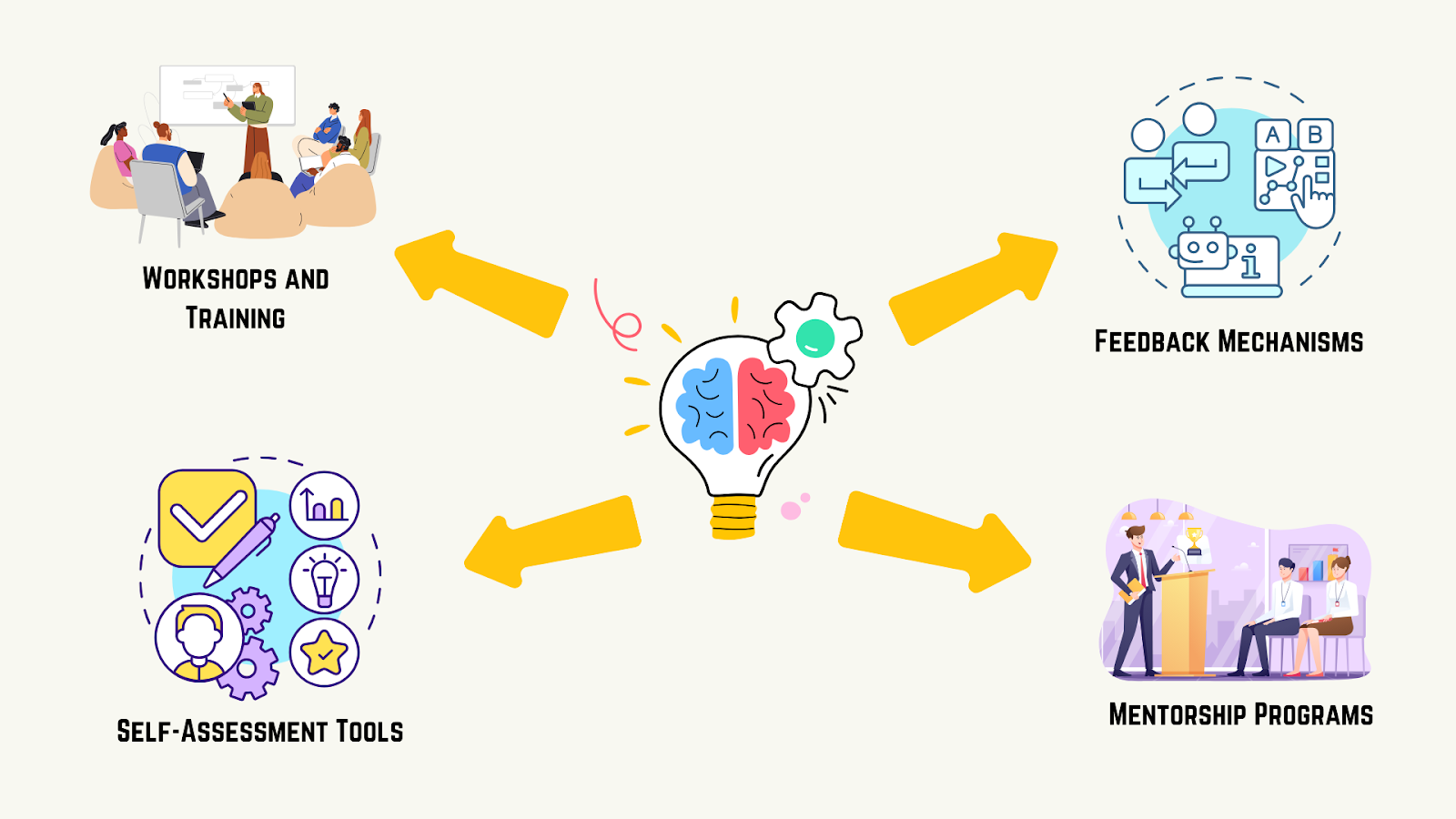
Power skills are not always inherent; with the right approaches, they can be developed and refined to support professional growth. Here are some effective strategies for cultivating soft skills in a tech-driven environment:
- Workshops and Training: Organizations can offer targeted workshops that address specific soft skills, such as conflict resolution, adaptability, or emotional intelligence. These training sessions allow employees to practice and strengthen skills in a structured setting, often with real-life scenarios that help them transfer learning to their roles.
- Feedback Mechanisms: Constructive feedback from peers and supervisors is essential for growth. Regular feedback sessions help individuals understand their strengths and areas for improvement, reinforcing positive behaviors and encouraging a continuous growth mindset.
- Self-Assessment Tools: Tools such as emotional intelligence quizzes, personality assessments, or communication style tests can provide valuable self-insight. By identifying areas that need improvement, employees can work more intentionally on specific soft skills, setting personal goals for development.
- Mentorship Programs: Pairing employees with experienced mentors allows for personalized guidance in developing soft skills. Mentors can offer advice and share experiences, especially in areas like leadership and adaptability, helping mentees learn from real-life examples.
Organizations that invest in these methods foster a culture of continuous improvement. By actively supporting soft skills development, they empower employees to succeed personally and professionally, which ultimately strengthens team dynamics, enhances collaboration, and drives long-term organizational success.
“Soft skills can be learned, practiced, and refined just like any other skill. It takes dedication and the right opportunities to grow,” says Gavin Yi, Founder and CEO at Yijin Hardware.
7. Integrating Soft Skills in Team Dynamics
Strong team dynamics are crucial in tech-driven environments, where projects demand diverse perspectives and collaborative efforts. Integrating soft skills into daily interactions is vital for fostering a productive, resilient team culture that can adapt to rapidly changing project needs and drive innovation. Here are some key strategies for building strong team dynamics through soft skills:
- Encourage Open Communication: Using tools like Slack or Microsoft Teams helps maintain clear, open, and accessible communication. These tools ensure that all team members, whether remote or on-site, are informed and can participate in discussions. Open communication reduces misunderstandings, keeps projects on track, and strengthens team cohesion.
- Promote Collaborative Problem-Solving: Inviting input from all team members fosters a collaborative environment where everyone feels valued and respected. This approach encourages innovative solutions by leveraging the unique strengths and ideas of each team member, ultimately leading to more creative and effective problem-solving.
- Embrace Empathy and Inclusion: By promoting empathy and emotional intelligence, companies can create an inclusive environment where each team member can thrive. Embracing diversity and understanding individual challenges build trust and ensure that all voices are heard.
These strategies are particularly important in remote or hybrid teams, where effective communication and empathy prevent misunderstandings, reduce isolation, and foster a supportive, connected environment that enhances productivity and morale, even across different locations.
“In tech teams, empathy and open communication aren’t just nice-to-haves—they’re essential ingredients for collaboration and success.” says Jay Barton, CEO of ASRV.
8. Future of Power Skills in a Tech-Driven Workplace
As technology continues to advance, the importance of soft skills in the workplace will only grow. These skills help professionals adapt to rapid technological changes and collaborate effectively in increasingly diverse, digital, and customer-oriented environments. Here’s a look at what the future holds for these essential soft/power skills:
- Increased Demand for Adaptability: With AI and automation taking over repetitive tasks, adaptability is becoming a defining skill. Tech professionals will need to learn and implement new tools and pivot quickly as roles and processes evolve. This flexibility enables them to stay relevant in an environment that demands ongoing upskilling and reskilling.
- Greater Emphasis on Critical Thinking: As machines handle routine tasks, the ability to tackle complex, non-linear problems will set professionals apart. Employers will increasingly value critical thinking skills that allow individuals to analyze information, connect insights, and develop innovative solutions. Creative problem-solving will be essential for driving progress and addressing unique challenges that automation cannot solve.
- Growing Importance of Emotional Intelligence: As tech workplaces and products become more customer-centered, emotional intelligence is essential for understanding and responding to clients’ needs. Emotional intelligence fosters empathy, trust, and a positive customer experience, which are critical for client satisfaction and loyalty. It also supports effective team dynamics, allowing professionals to communicate with sensitivity, manage conflicts, and contribute to a positive workplace culture.
In this evolving landscape, soft skills will serve as the backbone of successful, agile, and customer-focused teams.
9. The Impact on Career Advancement
The career advancement data in 2026 tells a consistent story. Hard skills get professionals into the room. Power Skills determine how far they advance once they are there.
The transition from individual contributor to team lead has always required more than technical ability. But in an AI-augmented environment, that transition is sharper. An AI agent can now do a meaningful portion of what a mid-level engineer does independently. What it cannot do is run a team, earn a client’s trust, or make a judgment call under pressure with incomplete information. Those capabilities belong entirely to the human side of the equation.
Organizations that understand this are restructuring their promotion criteria accordingly. Technical certification still matters for initial hiring. But the behavioral signals how someone communicates under pressure, how they respond to feedback, how they build trust across a cross-functional team are increasingly the primary factors in leadership selection.
“Career growth in tech isn’t just about what you know it’s about how you lead, communicate, and inspire others.” — David Tang, CEO and Founder of Flevy
10. Developing Power Skills in an AI-Driven Environment
Power Skills are not fixed traits. They are developed through practice, feedback, and intentional investment the same way technical skills are built, just through different mechanisms.
Workshops and scenario-based training remain the most effective format for building skills like conflict resolution, ethical judgment, and adaptability. The key is using real AI-era scenarios: what do you do when an AI gives you a confidently wrong answer before a client presentation? How do you communicate a technically complex AI decision to a board that does not understand the underlying model?
Mentorship is particularly high-value for Power Skill development because so much of what makes someone exceptional at communication or emotional intelligence is modeled behavior, not classroom instruction. Pairing junior professionals with leaders who have navigated the transition to AI-augmented work provides a level of context that no course can fully replicate.
11. The Future of Skill Synthesis
As AI continues to absorb more of the technical execution layer, the professionals who build lasting careers will be those who have invested in both sides of the equation. The hard skills signal that you can operate in a technical environment. The Power Skills signal that you can lead in one.
The organizations winning the talent competition in 2026 are those that hire for both and develop both. Companies that train only technical skills are building a workforce that AI will increasingly be able to replicate. Companies that develop Power Skills alongside technical capability are building something harder to replace: professionals who know how to use the tools, question the tools, and make the judgment calls the tools cannot make.
That synthesis is the defining professional edge of this decade.
Frequently Asked Questions
What are the most important IT skills for 2026? The top five in-demand skills for 2026 are AI Literacy (including prompt engineering and output validation), Cybersecurity, Communication (specifically translating technical data into business strategy), Critical Thinking, and Adaptability. The candidates who combine all five are the most competitive in the current market.
Why are soft skills now called Power Skills? Industry leaders including Robert Half and Korn Ferry rebranded soft skills as Power Skills to reflect their true strategic value. The word “soft” implied these abilities were secondary or optional. In 2026, skills like emotional intelligence, adaptability, and ethical judgment are primary drivers of promotion, leadership selection, and long-term organizational success.
Are hard skills becoming less important because of AI? Basic hard skills like entry-level coding or routine data processing — are being commoditized by AI. But higher-order technical skills are more important than ever. In 2026, the hard skill that matters most is AI literacy: knowing how to direct, validate, and build on AI outputs rather than simply executing tasks that AI can now handle autonomously.
What is the AI-augmented skills gap? The AI-augmented skills gap refers to the growing shortage of professionals who can bridge technical AI capability with business application. 62% of hiring managers report a wider skills gap than last year, specifically in finding candidates who can translate technical AI data into business strategy — a role that requires both hard technical literacy and Power Skills like communication and critical thinking.
What is a Human-AI Power Couple in the workplace? The Human-AI Power Couple describes the most valued employee profile in 2026: a professional who uses AI tools to handle repetitive, high-volume technical tasks, then applies their uniquely human Power Skills strategic thinking, client relationships, ethical judgment — to the work that AI cannot do. This combination produces output that neither a human nor an AI could achieve alone.
How do I know if I have the right skills for a tech role in 2026? Use the 2026 Skills Audit checklist in this article. The five areas to self-assess are AI Literacy, Cybersecurity awareness, Communication, Critical Thinking, and Adaptability. Candidates who can demonstrate all five through certifications, behavioral examples, or portfolio work are significantly more competitive than those who rely on technical credentials alone.
